

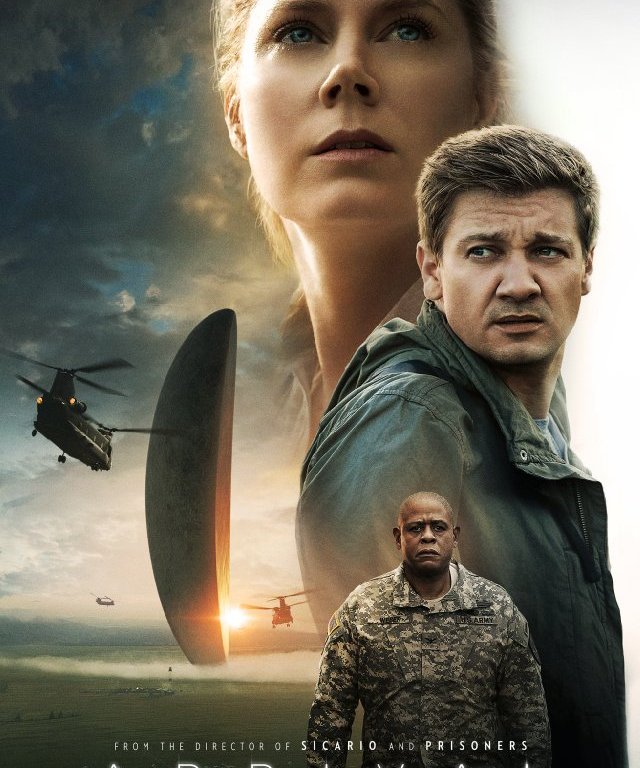

Arrival could technically be considered an alien invasion movie, but given that it lacks the action typically seen in the genre, “alien contact” would be the more appropriate term. The focus is instead on the looming potential of conflict, as sheer curiosity soon gives way to fears of war. Fresh off the widespread critical success of Prisoners, Enemy, and Sicario, director Denis Villeneuve has now added sci-fi to his quickly budding resume. For the most part, his latest effort, based on Ted Chiang’s short story “Story of Your Life,” is a rousing, thought-provoking examination of language and the unknown, as well as a character study on dealing with loss.

The “less is more” approach works well regarding Arrival‘s aliens (named Heptapods due to their seven tentacle-lined limbs), who appear in their physical entirety in just one scene. Initially we know nothing about them or their motivations beyond the fact that twelve of their spaceships hover at distinct locations all around the world. We’re treated to several grand, sweeping shots of the giant black oval ships, and inside them where gravity takes on curious properties. This is where Johann Johannsson’s haunting score really shines, helping to produce an atmosphere of heightened awe and uneasiness. Independence Day: Resurgence‘s aliens managed to leave remarkably less of an impression despite being hyperactive in comparison.

Villeneuve maintains a deliberate pace as the humans slowly learn more about the Heptapods and their intricate, but at the same time exceedingly efficient written language. The difficulties and logistics of attempting interspecies communication, in which certain rules and lines of thought are taken for granted by us but may be very different for them, are illustrated in detail. And as fears grow that their intentions are sinister, the race to understand their intentions only becomes more urgent. Most importantly, Arrival gets viewers as invested in the stakes as its characters.

After largely being wasted by a subpar script earlier this year in Batman v Superman, Amy Adams fares far better as a linguistics expert who is the best American hope to understanding why the Heptapods have come. Lois Lane will undoubtedly be remembered years from now over Louise Banks, but the reporter is not as fully realized of a character as the linguist, at least not Zach Snyder’s version. Adams effectively portrays Louise’s inner turmoil in coping with her daughter’s early death, standing out nicely in contrast to Anne Hathaway’s corny proclamations about love in Interstellar. Jeremy Renner is a decent sidekick as physicist Ian, and the source of Arrival‘s brief moments of levity, such as when he names their encountered Heptapod duo Abbott and Costello. Forest Whitaker rounds out the rest of the sparse cast of mostly anonymous and forgettable military members. From start to finish, the story is Adams-driven.
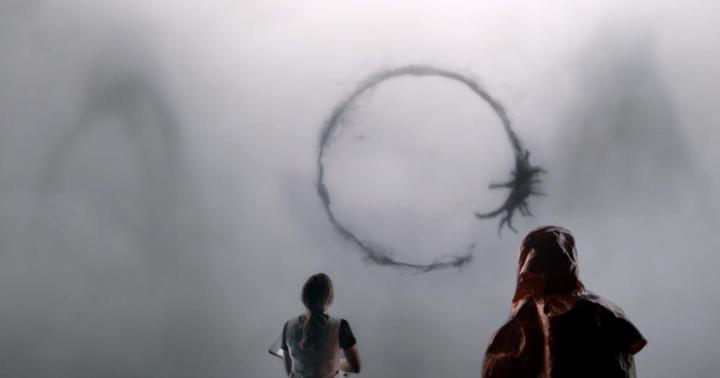
Arrival‘s third act gradually reveals a substantial twist that ties certain narrative and character aspects together unexpectedly. This swerve adds further topics of sci-fi and ethics discussion, though the last scenes will bring an unwelcome shift for those who are more interested in the film’s sci-fi elements. Is Arrival‘s thematic core more in line with first contact, or coming to terms with tragedy in one’s life? Depending on where you are in this spectrum, the ending could range from a fascinating addition of emotional layers to an annoying bait-and-switch.

I happen to fall more in the latter category, but Arrival‘s ending only represents a dent to a very solid foundation of heady concepts and nice visuals. Denis Villeneuve will continue exploring the sci-fi in the upcoming Blade Runner 2049 and has certainly earned my anticipation of whatever he does next.
 Dogomon